

How to have a steady, confident, and continuous line?
When looking at certain drawings, it is often both what stands out immediately and what can be very complicated to reproduce.
Mastering your stroke—meaning succeeding in freehand drawing of continuous lines(straight, curved, parallel) or regular circles—is an essential skill in drawing.
It will allow you to quickly draw a whole range of subjects: the stems of a plant, the antennae of an insect, the curve of a bird's or butterfly's wing...
These strokes are the basis of all drawing, since all subjects can be decomposed into basic shapes, whether 2D (square, circles, triangles...) or 3D (cubes, spheres, cones...).
Knowing how to visualize and trace straight lines freehand is also necessary for making perspective drawings.
In this article, we will see quick exercises to train this essential drawing skill. They can be done at any opportunity, on a simple corner of a sheet of paper.
Enjoy the discovery!
A learned gesture
The exercises we are going to see allow you to work on two things:
1. Your visual skills: it involves training yourself to see exactly what a straight line or a regular circle looks like so you can correct yourself and adjust your stroke. You will also be able to visualize your path before creating it.
2. Muscle memory: the repetition of these exercises will allow you to "teach your arm" to draw that straight line or circle, so that it eventually becomes easy and natural.
As we have seen, straight lines, curves, and circles are found absolutely everywhere.

A flower can be drawn from a cone, a butterfly from a rectangle.
A flower fits inside a circle (or an oval if seen in perspective). The stem is formed with closely spaced curved parallel lines.
A butterfly fits inside a rectangle, the body axis is a straight line, the antennae are parallel curved lines, and the wings are composed of many curves.
What tool to use for these exercises? What tool to use for these exercises?
I advise you to use a pen that cannot be erased, like a ballpoint pen or a felt-tip pen, rather than a pencil. For my part, I had trouble starting with this type of pen, but after testing it, I assure you they will really help you gain confidence in your line, which is the goal of these exercises. The fact that you cannot erase your stroke will make your drawing more committed and you will be more attentive. —————————————————————— After this theoretical part, let's see right away which exercises to do and how to do them!
Exercises to master your stroke
Drawing precise straight lines freehand
General advice
To draw a straight line, two approaches are possible: drawing the line by moving your pen away from you or by pulling it toward you.
The best thing is to draw a few lines in one direction, then a few in the other, to see what works best for you.
It is also easier to practice drawing lines in a single direction to start. When drawing, you can easily turn your paper according to the angle you need to draw your line.
One last tip for approaching these exercises: adapt the movement to the size of the line to be drawn.
In fact, you can draw a line from the fingers for short lines, the wrist for longer lines, the elbow, or even the shoulder for even longer lines.
The idea is to use only one of these parts (fingers, wrist, elbow, or shoulder) and keep the others fixed for more control over your stroke.
The longer the lines, the more complicated it will be to be precise, but that comes with training.
For the longest lines, relax your shoulder well before starting. These are the least obvious lines to draw, but with a bit of practice and patience, it eventually comes.

Exercises for drawing straight lines
Exercise 1: Drawing straight lines
For this first exercise, the idea is to draw straight lines of different lengths, trying each time to spot if the line curves a bit and in which direction. Draw a line, spot where it curves, and start again while adjusting (compensate by curving your stroke in the opposite direction) until you get a nice straight line.
The idea is not to make a straight line the very first time you do this exercise. Like any exercise, it requires being repeated several times.
Once you have done it a few times, and to really go for precision, you can check your line with a ruler and adjust as we have seen.

Exercise 2: Drawing parallel lines
The idea here is to draw parallel lines, more or less close together, and of different sizes.
This exercise will allow you to practice drawing straight lines and will also help you lay down values using hatching that is more or less close together.

Exercises to work on drawing precision
Exercise 1: Connecting two points
After working on drawing a straight line, we will see how to be a bit more precise by drawing a line between two given points.
This skill is useful in many cases.
Start by placing several points on your sheet, at various distances. The idea will be to connect these points, making sure they intersect.
To succeed more easily, try to visualize the line to be drawn before starting.
You can also repeat the movement without touching the pen to the paper, several times above your sheet, to clearly perceive the direction of the line to be drawn.
The further apart the points are, the more these two tips will be useful for gaining precision.
When the direction is good, draw your line using your fingers, wrist, elbow, or shoulder, depending on the length of the stroke.

Exercise 2: Lines that intersect at a single point
The idea here is to make lines intersect at the same point.

Exercise 3: Drawing a cube
Drawing a cube is a very good way to practice.
It allows you to work on all the aspects we have seen: drawing lines of different sizes, parallel lines, and lines between two specific points at various distances.
Cubes are also a great help for making perspective drawings more easily.
Start by drawing a horizontal line that represents the "horizon line." This line corresponds to the eye level of the observer.
Place two "vanishing points" on this line (VP1 and VP2): these are the points toward which the diagonal edges of our cube will converge (1).
Then, draw a vertical line, which corresponds to one of the edges of the cube (2).
Draw two straight lines starting from the top of this vertical line: one going toward the first vanishing point, one going toward the second (which forms a kind of "Y"). Make sure these lines are well-aligned with the vanishing points (3).
Repeat the operation starting from the bottom of our first edge, then close the first two faces using vertical strokes (4).
Finally, start from the corner on the right and join the left vanishing point. Do the same with the left corner joining the right vanishing point. These last two lines intersect to form the top face of the cube (5).

After this first part on straight lines, I suggest we continue and see how to practice drawing regular curves.
Exercises for drawing regular curves
Drawing parallel curved lines
Parallel curved lines are useful in many cases: they allow you to easily draw the stems of a plant, the antennae or legs of an insect...
As with straight lines, depending on the size of the stroke, use only the fingers, wrist, elbow, or shoulder.
The idea is to use them as fixed pivot points and keep all other parts of the arm still.
Practice drawing regular and parallel curved lines of different sizes using this approach. You'll see, it should be much easier!

Drawing a curved line that passes through fixed points
Often, for drawing, we need to draw lines by connecting two specific points.
To practice, you can place different points on your sheet and connect them with curved lines. The important thing is the regularity of the curve; if the line doesn't pass exactly through the point, it's not a big deal.
For a very regular line, try to stay one step ahead by looking at where the next point is before reaching the point you are aiming for.
If you are connecting three points, for example, spot where point 3 is before having fully arrived at point 2 to avoid making a sharp angle.

The last two very useful shapes to know how to draw freehand are the circle and the oval.
They will allow you, for example, to draw flowers more easily, seen from above or in perspective.
Let's look at that right away with the final part.
Exercises for drawing circles and ovals more easily
General advice
Whether drawing a circle or an oval freehand, a few tips can help you enormously.
As with straight lines, you can make the movement of the circle or oval several times in the air without touching the pen down.
Once the movement feels steady to you, you can place the pen on the paper and draw your circle or oval.
Start with a very light stroke, barely visible, before strengthening your line by pressing a bit harder on your pen. This will allow you to adjust your path.
Finally, try to draw the shape in a single smooth, continuous, and fairly rapid movement, rather than with small strokes. This will help you avoid making a line that is too straight or shaky.
Exercise for drawing circles
For this exercise, take the advice we just saw and practice drawing circles of different sizes.
To be more precise, at the end of each circle, try to see where the curve is less regular, where the circle is a bit flattened, for example. Draw a new circle while adjusting your path.
To help you see if your circle is regular, you can also place the center and rotate your paper. The less regular parts should be more obvious; you can circle them to spot them before starting again.

Exercise for drawing ovals
Take the advice from the general tips section above and draw a first oval.
Try to see if something is wrong with this oval: the goal is to avoid flat edges and pointed ends. Circle the parts to be corrected and start again to improve your ellipse. Another way to check if your oval is regular is to draw the shortest line that passes through the center. Then fold your paper along this line. The goal is for each half of the oval to overlap perfectly.

Another way to draw circles and ovals
Drawing a circle with a square
This approach is a bit slower but allows you to make a regular circle freehand and to "train your eye" on the appearance of a circle.
Start by drawing a square (1).
Then draw the diagonals to find the center.
Next, draw two straight lines that pass through this center to divide each side of the square in two. You have your first 4 reference points (2).
Then divide each half-diagonal of the square into 4 and place a reference point slightly beyond the first quarter starting from the corner of the square. Repeat the operation for each of the 4 corners (3).
The circle to be drawn passes through the 8 reference points placed (4).

Drawing an oval with a square
As we saw earlier, an oval is a circle seen in perspective.
To be convinced of this, you can draw a circle on your sheet, then tilt it: the circle turns into an oval!


How to draw an oval? We saw that a circle fits inside a square. A circle seen in perspective (our oval, then) fits inside a square seen in perspective.
And a square in perspective corresponds to one of the faces of our cube that we drew at the beginning of the article: it is actually a rhombus.

To place the reference points in this shape, you can then use the same tips as for drawing the circle with a square.
Connect the points and you will get a beautiful ellipse!

This allows you to train your eye on the appearance of a regular oval, but the best and most practical way remains succeeding in making an oval freehand.
Conclusion
All the drawings we can create are made up of straight lines and curved lines.
Whether it's for drawing or for placing construction lines that will help us set shapes and proportions, knowing how to make straight lines and regular curves freehand is therefore very important.
It is truly what makes the difference between a drawing with hesitant outlines and a precise drawing.
In this article, we have seen quick exercises to do that will allow you to learn to make precise straight lines, curves, and geometric shapes like circles and ovals.
These are exercises, so the idea is obviously not to succeed perfectly from the start. The more regularly they are repeated, the more your stroke will gain in precision and confidence. You will be able to make drawings more easily, more quickly, and more accurately.
The ideal is to do these exercises for short periods: 2 minutes, 5 minutes, or 10 minutes, but above all, regularly.
Alternate with 100% pleasure drawing and you should quickly see progress in your stroke!
I hope you enjoyed this article and that it made you want to try right now.
For that, you only need a scrap of paper, a pen or pencil, and a few minutes of your time.
If you have questions or things to share, see you in the comments section below; I will be happy to answer!
Your turn to play!
See you soon!
Resources
These exercise suggestions for training your stroke come from 3 books:
How to Draw: Drawing and Sketching Objects and Environments from Your Imagination, by Scott Robertson and Thomas Bertling
Drawing for Dummies, by Brenda Hoddinott
The Laws Guide to Nature Drawing and Journaling, by John Muir Laws

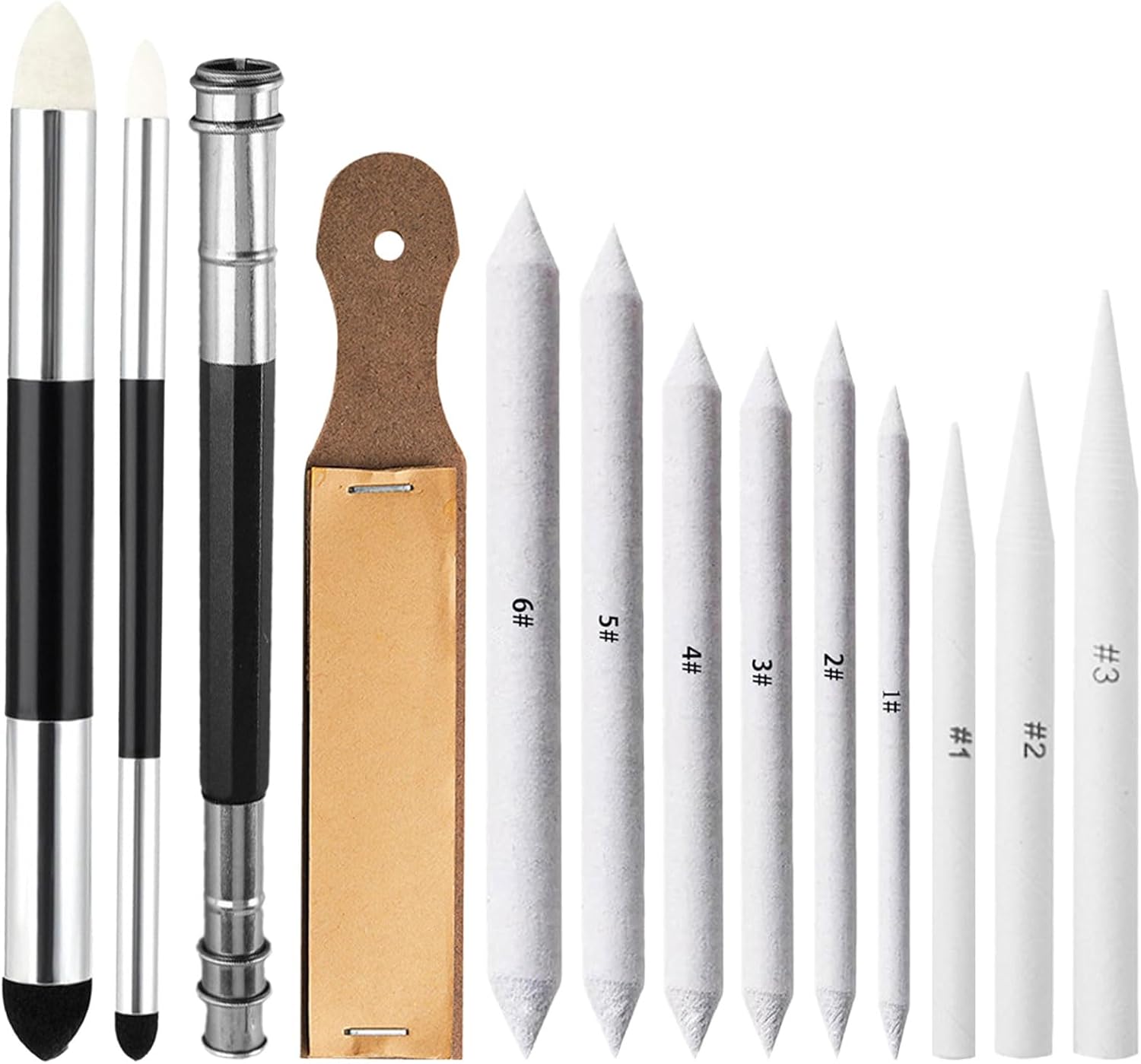


🔗 Liens affiliés Amazon Associates — En tant que Partenaire Amazon, je réalise un bénéfice sur les achats remplissant les conditions requises. Cela ne change pas votre prix.