

The basics of drawing require knowing two things: learning how to control your hand and learning how to see.
Tip : For the following 6 exercises, I suggest using a pen and a specific type of paper (for example, A5).
Dexterity — Two Exercises
The first two exercises focus on controlling your hand. We want to build muscle memory and train our hand-eye coordination. Mechanical exercises like these are perfect for beginners. Later on, you can use them to explore new pens or as a warm-up when you don’t yet know what to draw.
They are also wonderful ways to relax.
Exercise 1: Circles
Distribute circles of various sizes across a piece of paper until the page is full. Make sure the circles do not overlap.

Drawing circles is not as easy as you might think. Have you noticed how the circles become harder to draw as you create more of them? Try drawing them in both directions, and make plenty of them.
Tip : Shake out your hand if it starts to cramp.

Exercise 2: Hatching — The Joy of Structure
Fill a sheet of paper with parallel lines.

Diagonal lines are easier for us because they follow the natural movement of our wrist. Have you noticed that left-handed people prefer the opposite direction of right-handed people? Take a look at the drawings of your favorite artist (in my case: Leonardo), and guess which hand they used!

Now, make sure to try other directions as well. Have fun! Combine various hatching styles and enjoy watching the darkness spread across your paper.
Tip : Do not rotate the paper. The key here is to train your hand to feel comfortable in all directions.
Now that we have worked on our hands a bit, let’s train our eyes!
Perception — Learning to See
Drawing is essentially about seeing and understanding what you see. People often assume that everyone sees the same thing, but seeing is a skill that you can improve. The more you draw, the more you see. The following four exercises will help you see better.
Exercise 3: Outlines — Show me your hands!
Do you see all those fascinating outlines on your hand? Collect them on a piece of paper! Don’t try to draw the entire hand yet; just choose some of those beautiful lines.

Whether you are drawing a person, a plant, or your favorite animal, it is usually the outlines that define a recognizable body or object. The challenge here is not to try to perfectly reproduce these distinctive lines, but rather to see them!
Even if you think you already know the shape of an object, it is always worth taking a closer look and rediscovering it.
Exercise 4: Chiaroscuro — Folding Light and Shadow
Draw a piece of fabric. Start with the outlines and then—using your hatching skills—create a play of light and shadow.

Tip : You can use curved hatching to modulate shapes, and cross-hatch them to reach darker areas that look like woven structures.

Tip : Squint your eyes slightly when looking at the fabric. Everything will look blurry, but you will also see enhanced contrast between the light and the dark.

The arrangement of light is a great way to show what is important in an image. Take a look at the paintings of Rembrandt or Georges de la Tour. And the next time you watch a movie, look for the dramatic effects achieved through light and shadow.
Exercise 5: Perspective — Lost in Space
Let's draw some cubes! Follow the simple steps below.


Step 1 : Draw a horizontal line. This is the horizon of your image.

Step 2: Define two points on the horizon near the edges of the paper. These are your two vanishing points.

Step 3: Draw a vertical line somewhere.

Step 4: Connect the endpoints of the vertical line to the vanishing points.

Step 5: Add two vertical lines like this.

Step 6: Connect them to the vanishing points.

Step 7: Now, use a dark pencil or a pen to outline the cube. Voilà!

Repeat steps 3 to 7 as often as you like. Have fun! If you’re feeling adventurous, you might even try hatching the sides of the cubes.

Tip : When drawing lines that meet, it is generally better to be confident and let them overlap a little. The shapes will be better defined.

Mastering perspective drawing will give you the power to create illusions of depth. But above all, you are teaching your brain how to think in three dimensions.
So, even if you choose to create "flat" drawings, understanding perspective remains one of the most valuable drawing skills you can learn.
Exercise 6: Composition — Why is it there?
Make 5 different drawings of an object. Arrange the object differently on the paper each time!

Composition is an excellent tool for "saying" something with a drawing, for shaping its meaning or its message.
To understand how it works, keep in mind that our perception has been shaped by everyday experiences.
For example, horizontal and vertical lines feel more "stable" to us than diagonals, which could "fall" at any moment. And when we see a large dark shape at the bottom, we assume it must be "heavy."

As you try different arrangements of your subject on a piece of paper, notice how it changes their connotations — their meaning.


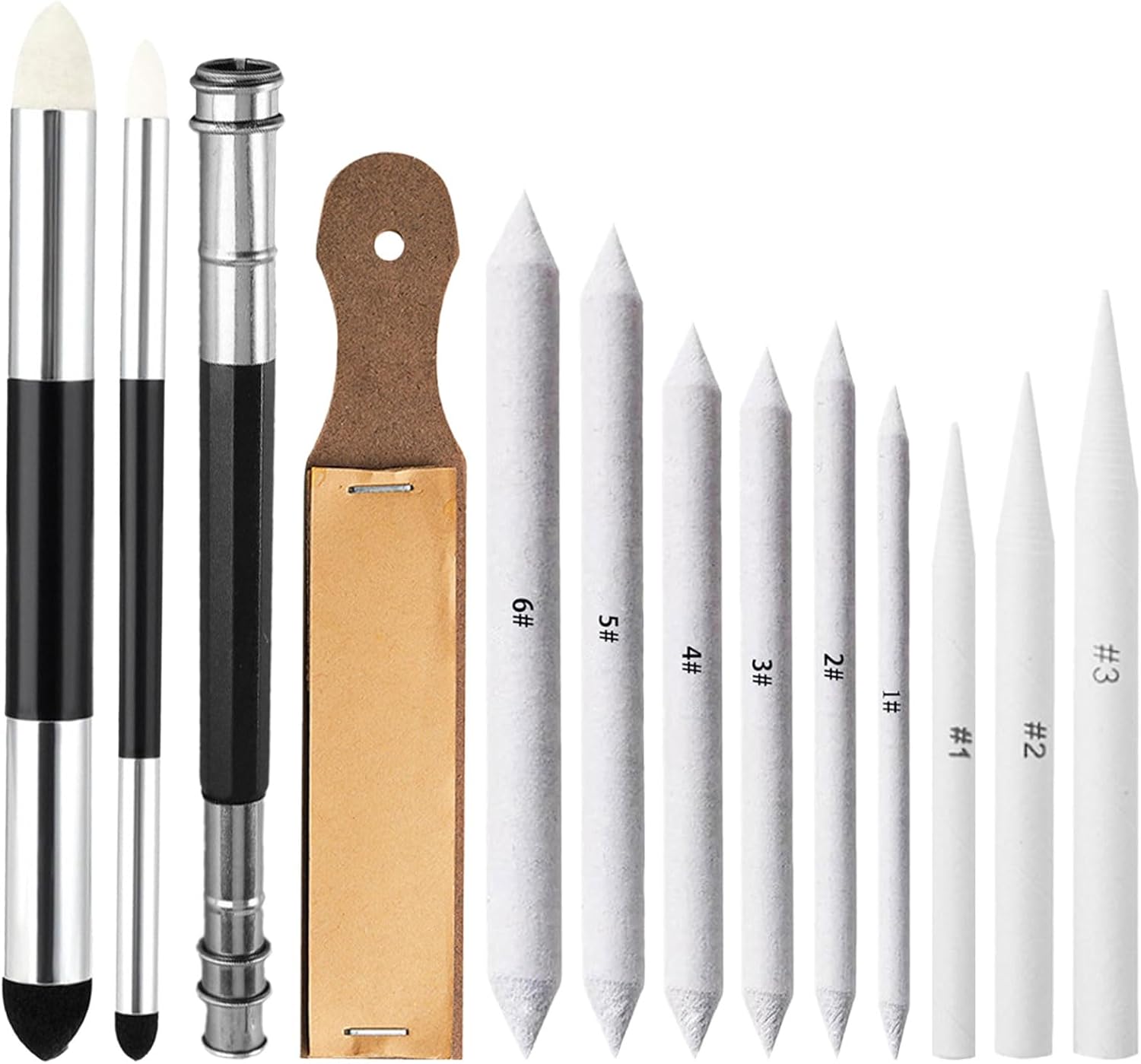


🔗 Liens affiliés Amazon Associates — En tant que Partenaire Amazon, je réalise un bénéfice sur les achats remplissant les conditions requises. Cela ne change pas votre prix.